
Article
How a Purpose-Built Grants Module Strengthens Council Funding, Governance and Delivery

And what is the true operational cost of managing multi-million-dollar grants in spreadsheets?
It’s true that most local governments can get by without a dedicated grant management software system. But at what cost?
Time spent chasing milestone updates across departments, major funding rounds discovered with only 48 hours to deadline, 40-page funding agreements buried in shared drives, and the lingering anxiety of compliance breaches or last-minute audit scrambles.
In many Australian councils, grant opportunities are identified informally, application details are drafted in disconnected Word documents, and post-award obligations are tracked across desktop spreadsheets, personal inbox folders, and informal handovers.
When a council only manages one or two small community grants a year, this manual approach can feel workable.
20%–50%+ of an Australian council's capital works and renewal budget is typically funded by external grants across Commonwealth, State, and disaster recovery funding streams.
For Australian local government, grant revenue is no longer a peripheral bonus it is the financial engine behind vital roads, community facilities, regional tourism, and water infrastructure. With over $125 billion in annual grant spending across Australia according to sector benchmarking from the Australian Institute of Grants Management (AIGM), the volume and compliance complexity of grants have reached historic highs.
When workloads surge, staff turn over, or funding rules tighten, councils relying on spreadsheets struggle to maintain a single view of where grant funds sit, whether delivery obligations are on track, or how cashflow aligns with physical project milestones.
What often gets missed becomes possible when grants are managed as an integrated, end-to-end lifecycle, from early pipeline discovery and AI-assisted drafting to automated agreement ingestion, milestone governance, and unified financial acquittal, connected directly into Council’s core ERP.
When grant management is structured, visible, and connected to council operations through dedicated SurePact-powered grant management software, councils gain the clarity to secure more funding, protect every dollar received, and deliver community infrastructure without burning out lean teams.
What a Good Local Government Grants Management System Should Do
Councils often start looking for grants management software for local government when the administrative drag of grant writing, spreadsheet reconciliation, and audit stress begins to wear teams down. At that point, the value is practical.
As a rule of thumb, an effective council grants management system helps organisations:
Find and secure high-value funding rounds earlier;
Keep multi-departmental delivery, milestones, and obligations moving; and
Support clear, audit-ready acquittals without relying on staff chasing updates across emails and spreadsheets.
It accomplishes this through a small set of everyday capabilities:
1. Intake, Search, and Strategic Pipeline Intelligence
Effective grant lifecycle management starts before an application is even drafted. Councils need a consolidated, real-time view of the funding landscape across federal platforms like GrantConnect (grants.gov.au), the business.gov.au Grants & Programs hub, state portals, and philanthropic trusts. When opportunities from over 200+ grant providers are indexed and searchable in one centralised directory, councils can identify relevant funding streams months ahead of closing dates. Intake is standardised through clear governance gates, such as internal 'Approval to Apply' sign-offs—allowing leadership to evaluate strategic alignment, co-contribution liabilities, and delivery capacity before committing valuable staff hours to a bid.
2. Enterprise Visibility and Clear Obligation Ownership
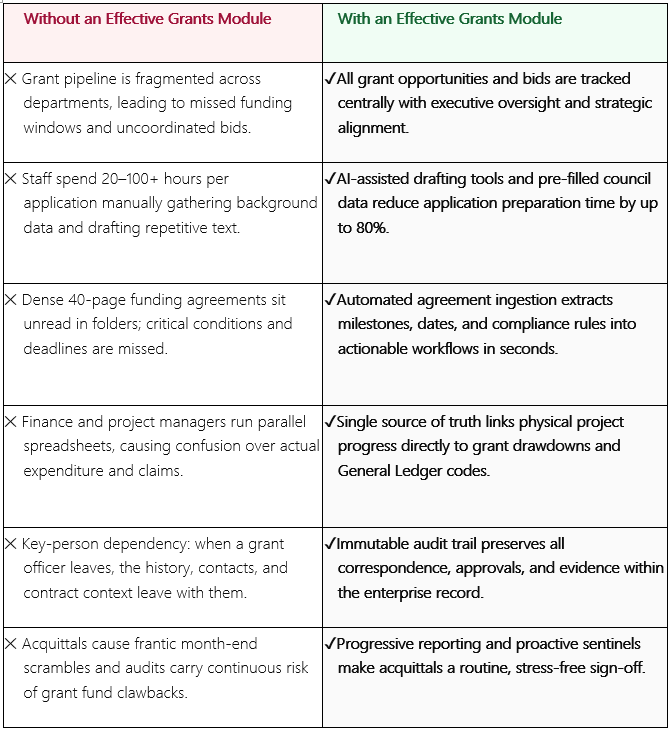
Staff across Executive, Corporate Services, Community Development, and Infrastructure need a single source of truth to see: what funding opportunities are being tracked, what applications are under review, which grant agreements are active, and who is accountable for each deliverable and acquittal. Each grant and obligation has a designated owner, so compliance conditions do not sit in a shared inbox or slip between departments. A centralised history of variations, funder correspondence, and progress notes ensures incoming staff can pick up a grant seamlessly, eliminating the immense key-person risk that occurs when staff change roles or leave council.
3. Automated Agreement Ingestion and Obligation Governance
Grant funding agreements (GFAs) are dense legal contracts spanning dozens of pages of schedules, milestones, special reporting conditions, and clawback clauses. Modern grant tracking software uses AI-driven agreement ingestion to extract contract conditions, payment schedules, matched funding requirements, and compliance obligations in under 60 seconds, automatically scheduling them as trackable milestones and tasks. This ensures delivery teams know exactly what evidence, geospatial photos, or reporting metrics the funder requires well before the acquittal deadline arrives.
4. Financial Clarity, Cashflow Forecasting, and AASB 15 Compliance
A grants management module must provide finance directors and CFOs with real-time clarity over: grant funds claimed versus unspent project balances, matched funding (co-contribution) commitments against council reserves, projected milestone billing and cashflow drawdowns, and compliance with AASB 15 & AASB 1058 revenue recognition standards for income received in advance. This removes the guesswork from quarterly budget reviews and guarantees that council never over-commits its own-source revenue.
5. Continuous Acquittal Readiness and Compliance Sentinels
Grant acquittal should never be an eleventh-hour crisis. Continuous tracking of project progress and financial expenditure against grant conditions means acquittal reporting is prepared progressively as work occurs. Built-in compliance sentinels proactively flag lagging expenditure velocity or approaching milestone deadlines early, safeguarding council against funding clawbacks or non-compliance penalties.
Translating Grant Lifecycle Capability into Real Council Outcomes
Where CouncilFirst Grants Management Fits: Integrated with the ERP
Once councils have a clearer way to track and manage grants, the next issue is how grant information connects to the rest of council work. If grants are managed in a standalone point solution or isolated spreadsheets, staff constantly end up re-entering project numbers, manually cross-checking purchase orders against grant agreements, and reconciling ledgers by hand. Over time, that creates double handling, data silos, and audit exposure. CouncilFirst includes Grants Management natively within the same environment used for broader council operations, connecting grant funding directly into:
Finance & General Ledger: Grant funding schedules, milestone claim billing, and matched-funding contributions align directly with the General Ledger and chart of accounts. Finance teams have instant visibility over unearned revenue, actual versus eligible expenditure, and cashflow timing.
Capital Projects & Works: Grant milestones tie directly into physical project delivery schedules, contractor progress, and job costing. Project managers can see which tasks satisfy funder requirements without leaving their operational workspace.
Asset Management: Infrastructure built or upgraded with grant funding (such as roads, bridges, sporting amenities, and water networks) connects directly into Council’s asset register, establishing immediate capitalisation, depreciation, and lifecycle maintenance plans.
Records & Governance: Executed funding agreements, Council resolutions, variation approvals, and funder communications are preserved within the enterprise electronic document management system (EDMS).
This gives the General Manager, CFO, and Director of Infrastructure a single pane of glass connecting the entire journey: from the dollar awarded → to the general ledger budget → to the physical works on site → to the long-term community asset.
Designed for Real Council Environments
It’s true to say that most councils, particularly in regional, rural, and growing communities, don’t have dedicated grant departments or spare administrative bandwidth. In many regional organisations, the same staff member might be balancing economic development, community grant applications, project delivery updates, and committee reporting. In that context, a grants management module only works if it is intuitive, actively reduces workload, and eliminates single-person dependency. By introducing automated agreement reading, centralised funding directories, and AI-assisted criteria drafting, the system does the administrative heavy lifting. Staff can generate compliant, evidence-backed grant applications in minutes using their council's adopted Community Strategic Plan (CSP) and past winning submissions.
Place-Based Funding and Community Impact
For local government, grants are not abstract balance sheet figures, they are physical, place-based investments in community outcomes. A grant represents a new shaded playground, a renewed timber bridge, a bushfire recovery center, or an upgraded water treatment plant. Connecting grant management to CouncilFirst’s spatial and asset records allows councils to see grant investment mapped across wards, townships, and facilities. Councils can identify which localities are receiving capital investment, where future grant applications should be targeted, and how funded projects deliver against Council’s Community Strategic Plan (CSP). This gives elected Councillors and executive teams the transparent reporting needed to showcase tangible delivery to their communities.
Final Thoughts & Next Steps
Grants management is often treated as a seasonal administrative chore or a scramble to meet ad-hoc deadlines. In reality, it plays a vital role in a council’s financial sustainability and community growth. When grant discovery, application drafting, project delivery, and acquittal are visible, consistent, and connected directly to the ERP, grants become a strategic engine for regional prosperity. If your council is still relying on manual spreadsheets to track millions of dollars in external funding, or if your teams are spending too much time chasing updates and piecing together acquittals, explore CouncilFirst Grants Management through a short demo to see how structured, ERP-connected grant management can work for your council. Let’s put your community First together.